A Java developer builds enterprise software, web back ends and Android apps in Java. This roadmap moves from programming logic in C to Core Java, HTML and CSS, Advanced Java and cloud concepts.
C trains you to think step by step with variables, loops, arrays and functions. Many Java learners in India start here, and it helps in technical interviews.
Learn classes, objects, inheritance, interfaces, exception handling, collections and multithreading, and write console programs that use them.
Java web applications send HTML pages to the browser. Knowing HTML forms and CSS styling helps you build and debug the screens your Servlets and JSP pages produce.
Connect to databases with JDBC and build dynamic web applications with Servlets and JSP, the base for frameworks such as Spring and Hibernate.
Enterprise Java services increasingly run on the cloud. Learn the core ideas of cloud computing, virtual machines, storage and security.
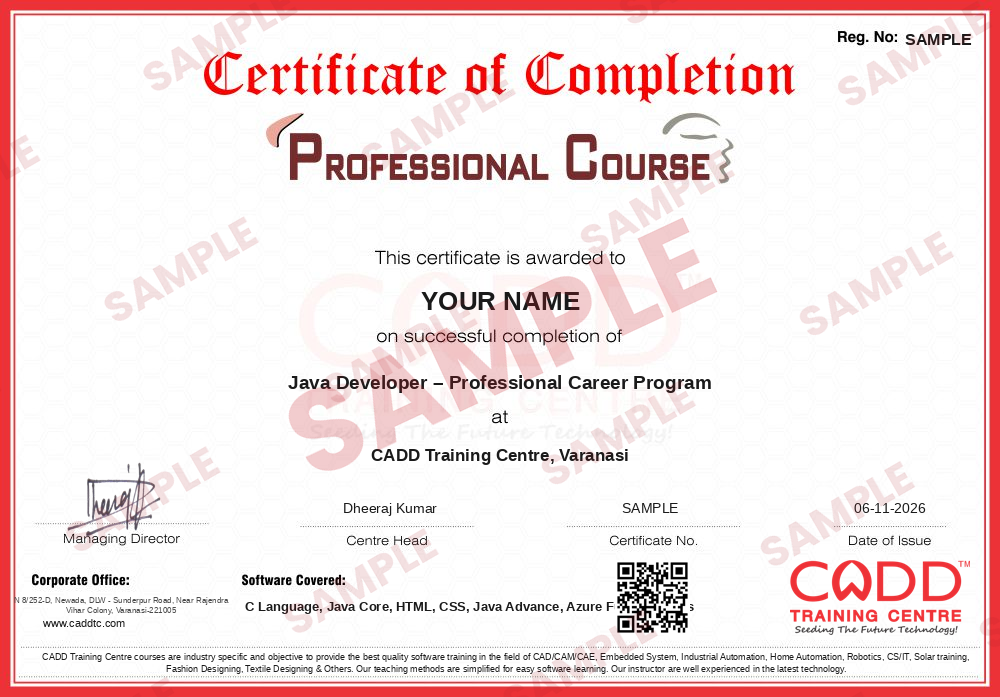
Finish the program and its project — you get the course-completion certificate and a digital completion badge with your name.
Take the certification exam: a theory test on the software of the program and a practical task of the job — at the centre or online.
Pass the exam and get the certified certificate with your marksheet. Anyone can check it online with its QR code.
Your certified badge — add it to LinkedIn and share it anywhere; it opens its own verify page.
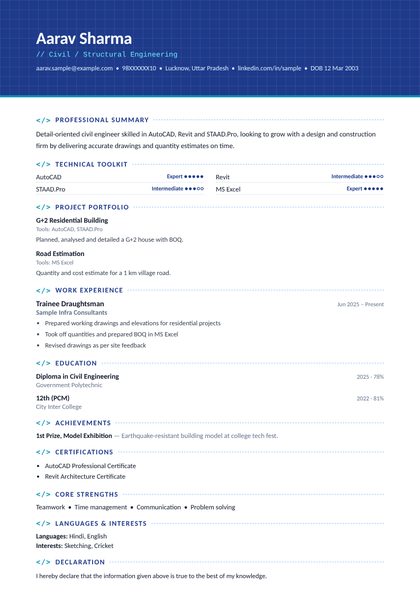
Make your CV in your student panel (Career → My CV) — your program, certificates and projects are added for you. Send it as a link with a preview picture, apply to jobs and answer Hire Me requests from companies.
The counsellor can shorten or extend this plan for your qualification and the time you have. Ask for your personal plan →
Join at the level that suits you — each level is a complete course you can enrol in.
Entry job — the first steps of the roadmap
The whole roadmap — every software of the job
A Java developer designs, codes and maintains applications written in Java, a language used for large business systems. Typical work includes writing classes and services, connecting applications to databases through JDBC, building web modules with Servlets and JSP or modern frameworks such as Spring Boot, writing unit tests, reviewing code with teammates and fixing production issues.
Banks, insurance companies, government portals, telecom operators, e-commerce platforms and large IT service companies run many of their core systems on Java, so most openings come from IT services firms, product companies and the in-house technology teams of large enterprises.
Demand stays strong because existing Java systems need constant upgrades and support, and new back-end services are still built on it. This roadmap builds logic with C, then object-oriented programming in Core Java, the HTML and CSS needed for web pages, and server-side programming in Advanced Java, ending with cloud basics. Learn SQL, Git and Spring Boot through projects alongside to become job-ready.
Master Core Java, then Advanced Java with JDBC, Servlets and JSP, learn SQL and practise data structures. Build two or three projects, ideally with Spring Boot, and prepare for the coding tests used in campus and off-campus hiring.
It is not compulsory, but C builds strong programming logic and many interview questions test it. If you already know another language well, you can start directly with Core Java.
This roadmap totals about 364 hours: C 80, Core Java 80, HTML 40, CSS 60, Advanced Java 80 and Azure Fundamentals 24. Skipping C brings it to about 284 hours.
Core Java covers the language itself: syntax, OOP, exceptions, collections and threads. Advanced Java covers building applications on top of it, such as database access with JDBC and web programming with Servlets and JSP.
Yes. Java runs a large share of banking, insurance, government and enterprise systems, and these need regular development and maintenance. It is also widely used for back-end services and Android apps.
Yes. Java is taught in live online classes as well as classroom batches at CADD Training Centre. You need a computer with the JDK and an IDE such as Eclipse or IntelliJ IDEA installed.
More questions? Ask our counsellor or see all career roadmaps.
 Embedded Systems EngineerAn embedded systems engineer programs the microcontrollers inside electronic products. This roadmap takes you from C and C++ through Arduino hardware, Proteus simulation and Python to entry-level firmware work.
 Python DeveloperA Python developer writes code for web apps, automation scripts and data tools. This roadmap takes you from core Python through web basics, spreadsheets and databases, and cloud concepts towards entry-level developer work.
 Web DeveloperA web developer builds and maintains websites and web applications. This roadmap covers HTML, CSS, web graphics, server-side Python and hosting basics so you can create and publish complete sites.
 Office Executive / Computer OperatorAn office executive keeps a company's documents, spreadsheets, email and records running smoothly. This roadmap takes you from computer basics to confident, job-ready use of Word, Excel, PowerPoint, Outlook and Tally.
 Government Computer OperatorGovernment computer operators handle typing, data entry and online records in public offices. This roadmap builds the computer skills and NIELIT qualifications, CCC and O Level, that many government recruitments ask for.
 Video EditorA video editor cuts raw footage into clear, engaging videos for YouTube, social media, events and businesses. This roadmap builds your graphics skills in Photoshop and Illustrator and your editing skills in Adobe Premiere Pro.