Classroom & live online80 HoursVerifiable certificateSyllabus ↓
Java Advance Course
Learn Advanced Java: JDBC, Servlets, JSP, MVC web apps and frameworks.
Your roadmap — from admission to certificate
1
Free counselling
Talk to our counsellor — choose the right course, batch time and mode.
2
Admission
Join at a CADD centre near you or online. You get your student login and ID card.
3
Learn step by step
80 Hours of hands-on Java Advance classes — in the classroom or live online.
Servlets and JSPsBasics of a Web applicationWeb Contaner and Web Application Project Set upServletsSession ManagementJSPsJSP ElementsJSP Tag libraryStruts Framework (version 2.x)Basics of MVC
4
Practice & project
Exercises in every class and a final project, checked by your trainer.
5
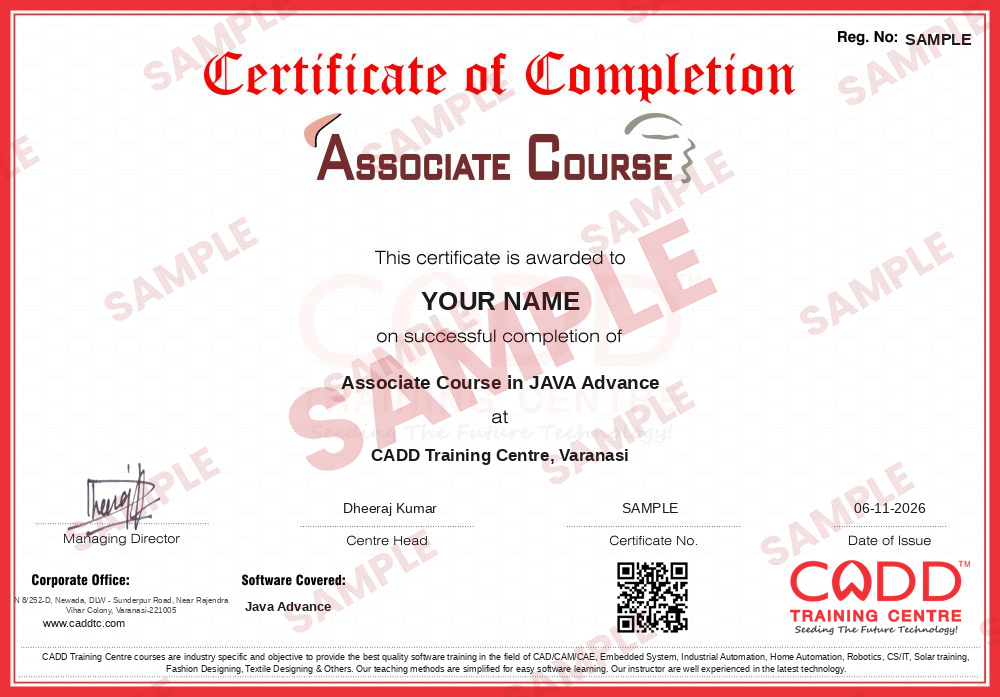
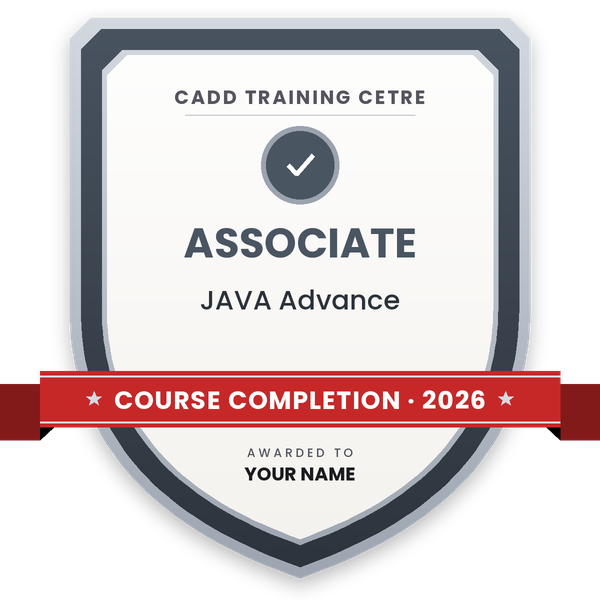
Course completion certificate + completion badge
Finish the course and get your course-completion certificate and a digital completion badge with your name.
With your name and year · its own verify link · “Add to profile” on LinkedIn
6
Certification exam
Take the certification exam: a theory test and a practical task — at the centre or online.
7
Certified certificate + marksheet
Pass the exam and get the certified certificate with your marksheet. Anyone can check it online with its QR code.
8
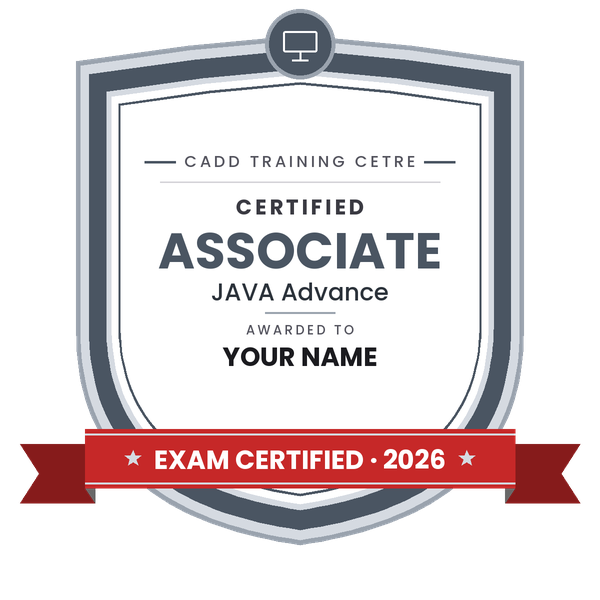
Certified badge
Your certified badge — add it to LinkedIn and share it anywhere; it opens its own verify page.
Certified badge
Course
Associate Course in JAVA Advance
Issued by
CADD Training Cetre
Training
Classroom or live online
How to earn
Pass the certification exam
You also get
Certified certificate + marksheet
With your name and year · its own verify link · “Add to profile” on LinkedIn
9
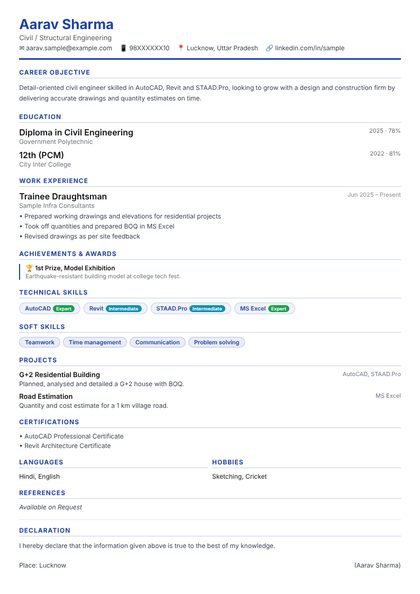
Make your CV & apply for jobs
Make your CV in your student panel (Career → My CV) — your course, certificates and projects are added for you. Send it as a link with a preview picture, and apply to jobs and Hire Me requests from companies.
Advanced Java is the server-side part of the Java platform used to build database-driven and web-based applications. Online banking portals, e-commerce back ends, booking systems and company intranets are commonly written with JDBC, Servlets and JSP, supported by frameworks such as Hibernate and Spring. It is the stage where a Java programmer starts building complete applications that real users can open in a browser.
This 80-hour Advanced Java course assumes you already know Core Java. You start by connecting programs to a relational database with JDBC and running create, read, update and delete queries. Next you build dynamic pages with Servlets and JSP on Apache Tomcat, and manage sessions, cookies, filters and request forwarding. The course then shows how to organise code with the MVC pattern and DAO classes, manage dependencies and builds with Maven, and introduces object-relational mapping with Hibernate and dependency injection with Spring. You finish by deploying a working database-connected web project you can show in interviews. Sessions are coding-focused and offered in CADD classrooms or live online.
The course supports roles such as Java developer trainee, back-end developer and web application developer. Spring Boot or a full-stack course is a strong follow-up.
You will be able to
Connect Java programs to a relational database with JDBC and run CRUD queries
Build dynamic web pages with Servlets and JSP running on Apache Tomcat
Manage sessions, cookies, filters and request forwarding in a web application
Organise a project with the MVC pattern and reusable DAO classes
Use Maven to manage dependencies and build a Java web project
Understand the basics of ORM with Hibernate and dependency injection with Spring
Deploy a complete database-driven web project as a portfolio piece
Who it is for
Students who have finished Core Java and want to build web applications
BCA, MCA, B.Tech and diploma CS/IT students preparing for campus interviews
Junior developers moving from desktop Java to server-side Java
Working professionals who need Java web skills for project work
What you need
Good knowledge of Core Java: classes, objects, collections and exceptions
Basic SQL (SELECT, INSERT, UPDATE, DELETE) is helpful
A PC or laptop with JDK, an IDE and MySQL installed for live online classes
Courses that include Java Advance
Associate Course in JAVA AdvanceAssociate Course · 80 Hours
03Web Contaner and Web Application Project Set up4 topics+
To set up Tomcat Container on a machine
To set up a Servlets JSP project in Eclipse
To configure dependency of Servlet JSP APIs
Web application project struture
04Servlets8 topics+
What are Servlets?
What can they do? Why are they needed?
How do Servlets look in code?
HTTP Methods; GET, POST, PUT, DELETE, TRACE, OPTIONS
GET/POST request; differences between the two
Servlet Lifecycle
Servlet Context and Servlet Config
Forwarding and Redirection of requests
05Session Management6 topics+
What is a session?
Why is it required?
How to get a session?
Session information passing between client and server
Sesssion information passing mechanisms - Cookies, Rewriting
How to destroy a session
06JSPs3 topics+
Introduction to JSP an dneed for JSPs
Basic HTML tags
JSP Lifecycle
07JSP Elements8 topics+
Scriptlets
Expressions
Declarations
Significance of above elements and fitment into the JSP Lifecycle
What are Directives in JSP?
Page Directive
Include Driective
Taglib Directive
08JSP Tag library5 topics+
JSP Standard Actions
Expression Language
JSTL basics and it's usage
Need for Custom Tag Library
Custom Tag Library implementation
09Struts Framework (version 2.x)0 topics+
Topics for this chapter will be added soon.
10Basics of MVC5 topics+
What is MVC?
MVC Type1 and Type2 architecture
Why Struts framework?
Struts 1 overview
Struts 1 and Struts 2 comparison
11Struts 2 Architectutre8 topics+
Architecture Diagram explanation of following components:
Components of Model, Views and Controller in Struts Framework
Interceptors
Model/Action classes
Value Stack
OGNL
Introduction to configurations; framework and application architecture
Declarative and Annotations configuration approaches
12Struts 2 set up and first Action class6 topics+
Download JAR files
Struts 2 project build up and Configuration files
To build Action class
To intercept an HTTP request via Struts2 framework using Action class
Defining data and business logic in Action class
Preparing and Forwarding control to Views
13Struts 2 Interceptors6 topics+
What are Interceptors
Responsibilities of an Interceptor
Mechanism of Interceptor calling in Struts 2
Defining Interceptors
Defining Interceptor stacks
Defining Custom Interceptors
14Struts 2 Tag Library1 topic+
Introduction to tag library of Struts 2 and it's usage
15Struts 2 Validations4 topics+
Validations using Validateable interface
Workflow interceptor mechanism for validations
Validation Framework introduction and architecture
Validating user input with above two mechanisms
16Struts 2 Tiles Frameworks5 topics+
Introduction to Tiles in a page
Struts2 Tiles framework introduction
Defining tiles.xml file
Configuring pages for tiles
A complete Tiles example with Struts2
17Hibernate Framework (version 3.x)0 topics+
Topics for this chapter will be added soon.
18Introduction3 topics+
What is ORM principle?
Why ORM?
ORM implementations
19Hibernate Architecture3 topics+
Introduction to Hibernate
Hibernate Architecture
What are Peristent classes?
20Hibernate CRUD8 topics+
Setting up Hibernate project
Configuring all JARs and XML files
Setting up connection to DB using Hibernate
Performing basic CRUD operations using Hibernate API
Object Identity; Generator type classes
Using SQL with Hibernate
Using HQL
Using Criteria queries
21Mapping Collections and Associations5 topics+
To define sets, mas, lists in Hibernate
Association Mappings: 1. One to one
2 One to many
3 Many to one
4 Many to many
22Hibernate Caching3 topics+
What is caching?
What are the types of caching in Hibernate?
Explanation of various caching mechanisms in Hibernate
23Using Hibernate Annotations (if time permits)1 topic+
Sample example of using Hibernate Annotations
24Spring Framework (version 3.x)0 topics+
Topics for this chapter will be added soon.
25Introduction to spring2 topics+
What is Spring?
Spring Architecture explanation and all it's components
26Introduction to all modules of spring7 topics+
Spring Bean Factory
Spring Application Context
Spring DI
Spring AOP
Spring Integration; Spring messaging, Spring JMS
Spring MVC
Spring DAO
27Setting up spring3 topics+
Setting up of Spring framework
Download JARs
Configure XML files
28Dependency Injection3 topics+
What is Dependency Injection?
How is it implemented using Spring Framework?
Bean Wiring mechanisms in Spring
29Spring AOP2 topics+
What is Spring AOP?
Implementation of Spring AOP
Ratings & reviews
Students rate the course after they finish it — their ratings appear here.
Java Advance course — FAQ
What is Advanced Java used for?
Advanced Java covers the server-side part of Java: connecting to databases with JDBC and building web applications with Servlets, JSP and frameworks. Banking portals, e-commerce back ends and enterprise systems are commonly built this way.
Can I learn Advanced Java without Core Java?
No. You should be comfortable with Core Java first, including OOP concepts, collections and exception handling. If you are new to Java, start with our Core Java course and then join Advanced Java.
How long is the Advanced Java course?
The Advanced Java course runs for 80 Hours of guided, hands-on training, with coding practice in every session and a small web project towards the end.
Are Advanced Java classes available online?
Yes. Choose a classroom batch at a CADD Training Centre or live online Advanced Java classes; online learners run Tomcat and MySQL on their own laptop with the trainer's guidance.
Will I get a certificate after the Advanced Java course?
Yes. Completing Advanced Java brings a CADD Training Centre certificate that anyone can confirm online. Show it together with your Servlet and JSP web project during interviews.
What jobs can I get after learning Advanced Java?
Advanced Java skills help you apply for roles such as Java developer trainee, back-end developer, web application developer and software support engineer. Adding Spring Boot later strengthens your profile further.
What is the difference between Core Java and Advanced Java?
Core Java teaches the language itself: syntax, OOP, collections and threads. Advanced Java uses that knowledge to build database-connected and web-based applications with JDBC, Servlets, JSP and related frameworks.