Classroom & live online 80 Hours Verifiable certificate Syllabus ↓

Java Core Course

Learn Core Java: OOP, packages, exceptions, strings, collections, multithreading, file I/O and JDBC.

Your roadmap — from admission to certificate

  1. Free counselling

    Talk to our counsellor — choose the right course, batch time and mode.

  2. Admission

    Join at a CADD centre near you or online. You get your student login and ID card.

  3. Learn step by step

    80 Hours of hands-on Java Core classes — in the classroom or live online.

    Introduction of Core java ProgrammingData types and OperatorsControl Flow statementsOOPS and its application in JavaPackagesMiscellaneousStaticsConstructorsExceptions in JavaStrings in Java
  4. Practice & project

    Exercises in every class and a final project, checked by your trainer.

  5. Course completion certificate + completion badge

    Finish the course and get your course-completion certificate and a digital completion badge with your name.
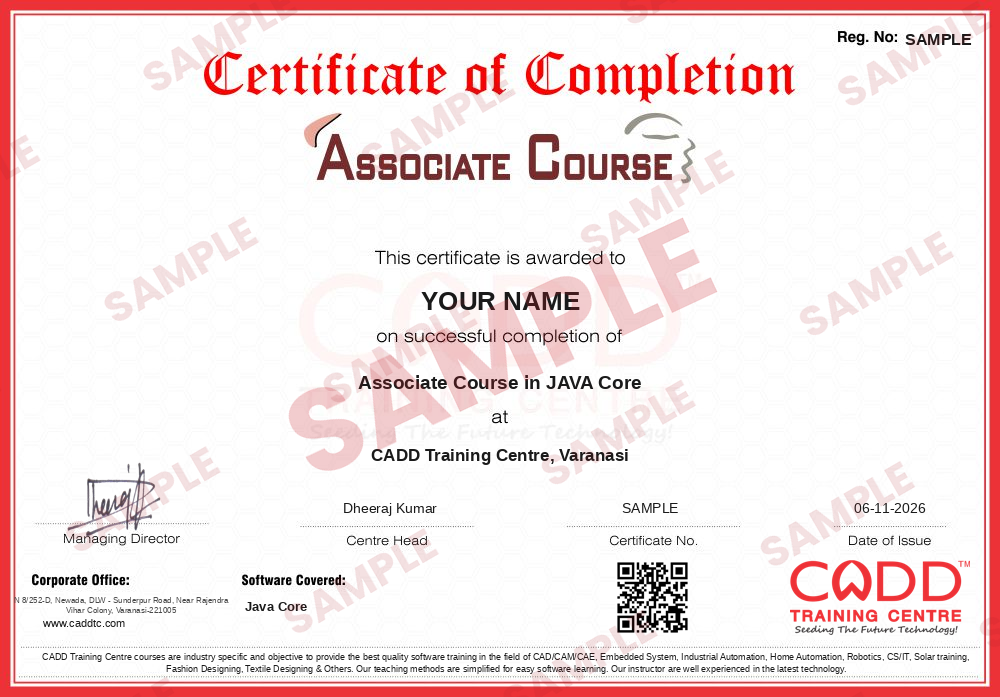
    Sample course-completion certificate — Associate Course in JAVA Core
    Course-completion certificate (sample) — Associate Course in JAVA Core · verifiable online
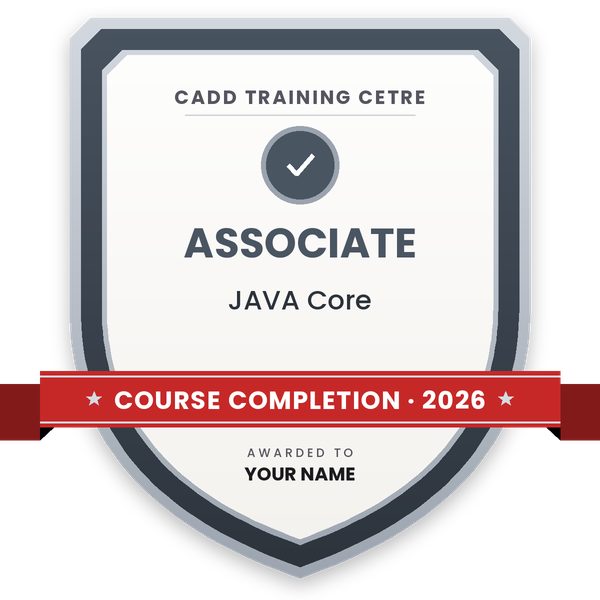
    Course-completion badge — Associate Course in JAVA Core
    Course-completion badge
    Course
    Associate Course in JAVA Core
    Issued by
    CADD Training Cetre
    Training
    Classroom or live online
    How to earn
    Complete the course and its project
    With your name and year · its own verify link · “Add to profile” on LinkedIn
  6. Certification exam

    Take the certification exam: a theory test and a practical task — at the centre or online.

  7. Certified certificate + marksheet

    Pass the exam and get the certified certificate with your marksheet. Anyone can check it online with its QR code.

  8. Certified badge

    Your certified badge — add it to LinkedIn and share it anywhere; it opens its own verify page.
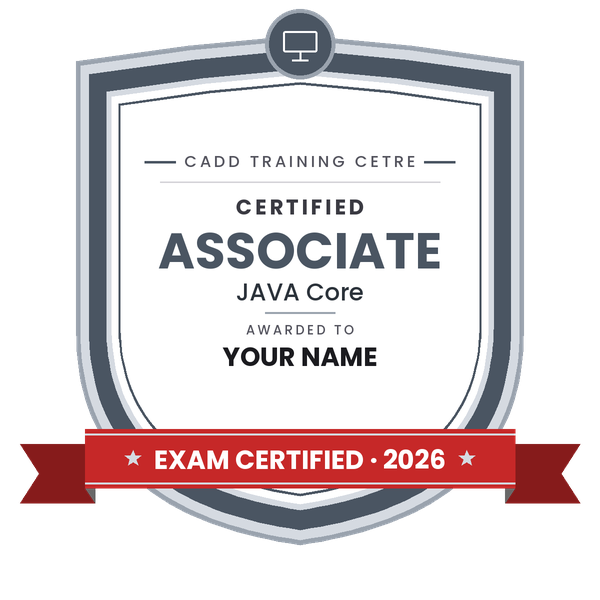
    Certified badge — Associate Course in JAVA Core
    Certified badge
    Course
    Associate Course in JAVA Core
    Issued by
    CADD Training Cetre
    Training
    Classroom or live online
    How to earn
    Pass the certification exam
    You also get
    Certified certificate + marksheet
    With your name and year · its own verify link · “Add to profile” on LinkedIn
  9. Make your CV & apply for jobs

    Make your CV in your student panel (Career → My CV) — your course, certificates and projects are added for you. Send it as a link with a preview picture, and apply to jobs and Hire Me requests from companies.

About the Java Core course

Java is an object-oriented programming language known for running the same compiled code on any system with a Java Virtual Machine. Banks, e-commerce companies, enterprise software firms and Android developers use it widely, and Core Java refers to the language itself and its standard libraries, the base on which web frameworks and Android apps are built.

The 80-hour Core Java course begins with installing the JDK and writing, compiling and running programs in an IDE. You learn data types, operators, control statements and arrays, then spend substantial time on object-oriented programming: classes, constructors, inheritance, interfaces, abstract classes and polymorphism. Packages and access modifiers show how real projects are organised. You also handle checked and unchecked exceptions, work with String and StringBuilder, and use the Collections Framework with List, Set and Map. The final modules introduce multithreading, file input and output, and connecting to a database with JDBC. Each concept is practised through coding exercises, in the classroom at CADD centres or in live online classes.

Core Java is the starting point for careers such as Java developer, backend developer, Android developer and software tester. The logical next step is our Advanced Java course, which covers Servlets, JSP and web applications.

You will be able to

  • Install the JDK and write, compile and run Java programs in an IDE
  • Use data types, operators, control statements and arrays in Java
  • Apply OOP in Java: classes, constructors, inheritance, interfaces and polymorphism
  • Organise code in packages and use access modifiers correctly
  • Handle errors with checked and unchecked exceptions
  • Use String, StringBuilder and the Collections Framework: List, Set and Map
  • Write multithreaded programs, read and write files and connect to a database with JDBC

Who it is for

  • BCA, MCA, B.Tech and B.Sc. computer students
  • Beginners who want to start a career in software development
  • C or C++ learners moving to Java
  • Learners planning Advanced Java, Spring Boot or Android development

What you need

  • Basic computer skills; any earlier programming knowledge is helpful
  • Logical thinking and school-level maths
  • A Windows PC or laptop with at least 4 GB RAM and a stable internet connection for live online classes

Courses that include Java Core

Associate Course in JAVA CoreAssociate Course · 80 Hours
Enquire →
Associate Course in C & Java CoreAssociate Course · 160 Hours · 2 software
Enquire →
Associate Course in C, Java Core & PythonAssociate Course · 220 Hours · 3 software
Enquire →
Programming Using C, C++ and JAVA CoreAssociate Course · 240 Hours · 3 software
Enquire →
Java Developer – Associate Career ProgramAssociate Career Program · 260 Hours · 4 software
Enquire →
Java Developer – Professional Career ProgramProfessional Career Program · 364 Hours · 6 software
Enquire →

Java Core Syllabus

21 chapters · 173 topics
01 Introduction of Core java Programming 6 topics
  1. Introduction to Java; features of Java
  2. Comparison with C and C++
  3. Download and install JDK/JRE (Environment variables set up)
  4. The JDK Directory Structure
  5. First Java Program through command prompt
  6. First Java Program through Eclipse
02 Data types and Operators 22 topics
  1. Primitive Datatypes, Declarations, Ranges
  2. Variable Names Conventions
  3. Numeric Literals, Character Literals
  4. String Literals
  5. Arrays(One dimensional; two- dimensional)
  6. Array of Object References
  7. Accessing arrays, manipulating arrays
  8. Enumerated Data Types
  9. Non-Primitive Datatypes
  10. Defining a class, variable and method in Java
  11. Method Signature; method calls
  12. Expressions in Java; introduction to various operators
  13. Assignment Operator
  14. Arithmetic Operators
  15. Relational Operators
  16. Logical Operators
  17. Conditional Operators
  18. Operator Precedence
  19. Implicit Type Conversions
  20. Upcasting and downcasting
  21. Strict typing
  22. Type conversion
03 Control Flow statements 8 topics
  1. Statements and it's various categories in Java
  2. if, if-else, if-else-if
  3. switch case
  4. for statement (both flavours traditional and enhanced for)
  5. while and do-while loops
  6. The continue Statement; labelled continue statement
  7. The break Statement; labelled break statement
  8. return statement
04 OOPS and its application in Java 24 topics
  1. Classes and Objects
  2. Defining a class;Defining instance variables and methods
  3. Creating objects out of a class
  4. Method calls via object references
  5. Abstraction
  6. Interfaces and Abstract classes
  7. Abstract and non-abstract methods
  8. Inheritance
  9. extends and implements keywords in Java
  10. Super class and Sub class
  11. this keyword, super keyword in Java for inheritance
  12. Concrete classes in Java
  13. Polymorphism
  14. Compile time polymorphism -- Overloading of methods
  15. Run time polymorphism -- Overriding of methods
  16. Method Overriding rules and method overloading rules
  17. Introduction to Object class and it's methods
  18. Encapsulation
  19. Protection of data
  20. Java Bean, POJO
  21. Getters/Setters
  22. Memory management in Java
  23. Heap
  24. Stack
05 Packages 4 topics
  1. Need for packages
  2. What are packages; package declaration in Java
  3. Import statement in Java
  4. How do packages resolve name clashes?
06 Miscellaneous 5 topics
  1. Var-Args
  2. Reference variables, local variables, instance variables
  3. Memory allocations to variables
  4. Double equals operator(==) operator for primitives and objects
  5. toString() method on an object
07 Statics 4 topics
  1. Static variables and methods
  2. Static imports
  3. Static initialization blocks; instance intialization blocks
  4. Static concept in inheritance
08 Constructors 8 topics
  1. What are Constructors?
  2. Properties of Constructors
  3. Default and Parameterized Constructors
  4. Rules for constructor implementation
  5. Constructor Chaining
  6. this call; super call for constructors
  7. Constructors for Enumerated Data Types
  8. Constructors concept for Abstract classes and interfaces
09 Exceptions in Java 14 topics
  1. What are Exceptions?
  2. Need for exceptions
  3. How can Exceptions be coded in Java?
  4. API heirarchy for Exceptions
  5. Types of Exceptions
  6. Keywords in Exception API: try, catch, finally, throw, throws
  7. Rules for coding Exceptions
  8. Declaring Exceptions
  9. Defining and Throwing Exceptions
  10. Errors and Runtime Exceptions
  11. Custom Exception
  12. Assertions
  13. What are Assertions?
  14. Enabling and disabling assertions in development environment
10 Strings in Java 7 topics
  1. What are Strings?
  2. String heap memory and Constant Pool memory
  3. Immutability in Strings
  4. String creation on heap and constant pool
  5. Method APIs on String; operations on Strings
  6. Mutability of String Objects - StringBuilder and StringBuffer
  7. Splitting of Strings and StringTokenizer class
11 Collection Framework in Java 15 topics
  1. The Collections Framework
  2. The Set Interface
  3. Set Implementation Classes
  4. The List Interface
  5. List Implementation Classes
  6. The Map Interface
  7. Map Implementation Classes
  8. Queue Interface
  9. Queue Implmentation classes
  10. Utility classes
  11. Sorting collections using utility methods
  12. equals() and hashCode contract in Java collections
  13. overriding equals and hashCode methods in Java
  14. New Collections added in Java 1.6
  15. Primitive wrapper classes and all its method APIs
12 Generics 3 topics
  1. Generics for Collections
  2. Generics for class
  3. Generics for methods
13 Input-Output in Java 7 topics
  1. What is a stream?
  2. Overview of Streams
  3. Bytes vs. Characters
  4. Overview of the entire Java IO API
  5. Reading a file; writing to a file usinf various APIs
  6. Reading User input from console
  7. PrintWriter Class
14 Serialization 6 topics
  1. Object Serialization
  2. Serializable Interface
  3. Serialization API
  4. ObjectInputStream and ObjectOutput
  5. Transient Fields
  6. readObject and writeObject
15 Inner Classes 5 topics
  1. Inner Classes
  2. Member Classes
  3. Local Classes
  4. Anonymous Classes
  5. Static Nested Classes
16 Threads in Java 8 topics
  1. Non-Threaded Applications
  2. Threaded Applications
  3. Process based multitasking Vs Thread based multitasking
  4. Thread API in Java
  5. Creating Threads
  6. States of a Thread
  7. Sychronization for threads; static and non-static synchronized methods; blocks; concept of object and class locks
  8. Coordination between threads - wait, notify and notifyAll methods for inter-thread communication
17 Applets 6 topics
  1. What are applets?
  2. Need for Applets
  3. Different ways of running an applet program
  4. Applet API heirarchy
  5. Life Cycle of an applet
  6. Even Handlers for applets, mouse events, click events
18 Swing GUI 7 topics
  1. Introduction to AWT
  2. Introduction to Swing GUI
  3. Advantages of Swing over AWT
  4. Swing API
  5. Swing GUI Components
  6. Event Handlers for Swing
  7. Sample Calculator application using Swing GUI and Swing Event handling
19 JDBC 8 topics
  1. What is JDBC; introduction
  2. JDBC features
  3. JDBC Drivers
  4. Setting up a database annd cretaing a schema
  5. Writing JDBC code to connect to DB
  6. CRUD Operations with JDBC
  7. Statement types in JDBC
  8. Types of Rowset, ResultSet in JDBC
20 Access Modifers in Java 5 topics
  1. What are access modifiers?
  2. Default
  3. Protected
  4. Private
  5. Public
21 Debugging of Java Programs in Eclipse. 1 topic
  1. Debugging of Java Programs in Eclipse.

Ratings & reviews

Students rate the course after they finish it — their ratings appear here.

Java Core course — FAQ

What is Core Java?

Core Java is the base of the Java language: syntax, object-oriented programming, packages, exceptions, strings, collections, multithreading, file handling and JDBC. Advanced Java and frameworks are built on it.

Can a beginner learn Java?

Yes. Java has clear rules and good error messages, which suits beginners. The course starts from installing the JDK and writing the first program, then builds up to OOP and collections.

How long is the Core Java course?

The Core Java course is 80 hours long. The counsellor will share batch timings for your centre or for live online classes.

Can I learn Core Java online?

Yes. CADD Training Centre runs Core Java in the classroom and as live online classes. You install the free JDK and an IDE such as IntelliJ IDEA, Eclipse or VS Code on your computer.

Will I get a certificate after Core Java?

Yes. Core Java learners get a CADD Training Centre certificate on completion. Its online verification, by QR code or code number, makes it easy to attach to job applications.

What is the difference between Core Java and Advanced Java?

Core Java covers the language and its standard libraries. Advanced Java builds web and enterprise applications with Servlets, JSP and frameworks such as Spring, and needs Core Java first.

What jobs need Core Java?

Core Java is the base for roles such as Java developer, Android developer, backend developer and software tester, after further practice with frameworks and projects.

More questions? Ask our counsellor or read the general FAQ.
Java Core80 Hours
Enquire now