Classroom & live online 80 Hours Verifiable certificate Syllabus ↓

C++ Language Course

Learn C++ with OOP: classes, inheritance, polymorphism, templates, exceptions, file handling and STL.

Your roadmap — from admission to certificate

  1. Free counselling

    Talk to our counsellor — choose the right course, batch time and mode.

  2. Admission

    Join at a CADD centre near you or online. You get your student login and ID card.

  3. Learn step by step

    80 Hours of hands-on C++ Language classes — in the classroom or live online.

    Introduction to C++Data Types, Variables and OperatorsControl StatementsFunctionsArrays, Strings and PointersClasses and ObjectsOperator Overloading and Type ConversionInheritance and PolymorphismTemplates and Exception HandlingFile Handling and the STL
  4. Practice & project

    Exercises in every class and a final project, checked by your trainer.

  5. Course completion certificate + completion badge

    Finish the course and get your course-completion certificate and a digital completion badge with your name.
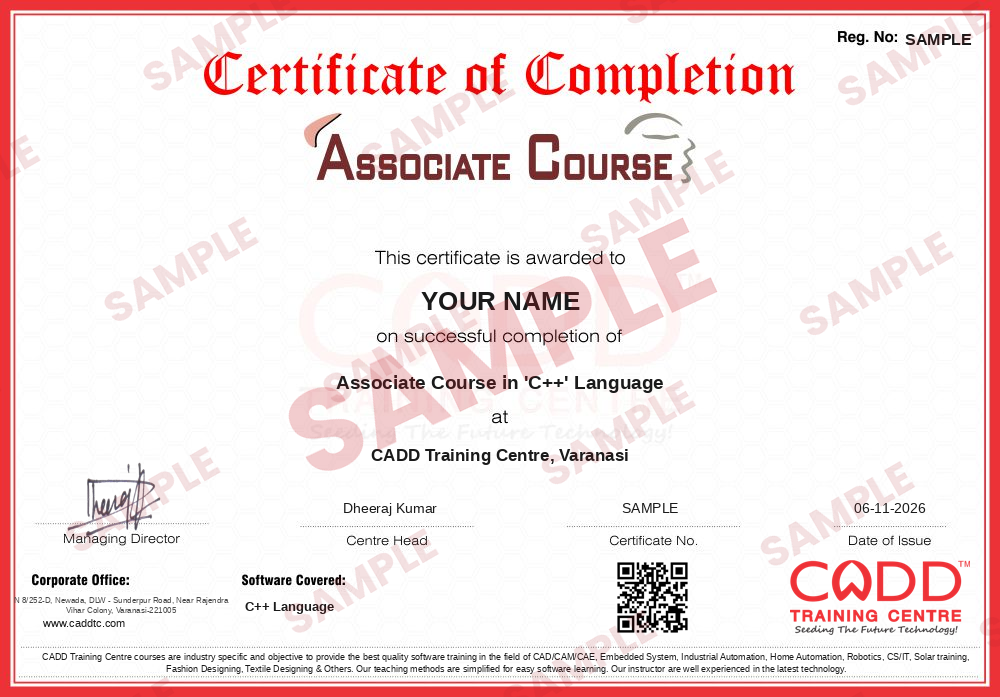
    Sample course-completion certificate — Associate Course in 'C++' Language
    Course-completion certificate (sample) — Associate Course in 'C++' Language · verifiable online
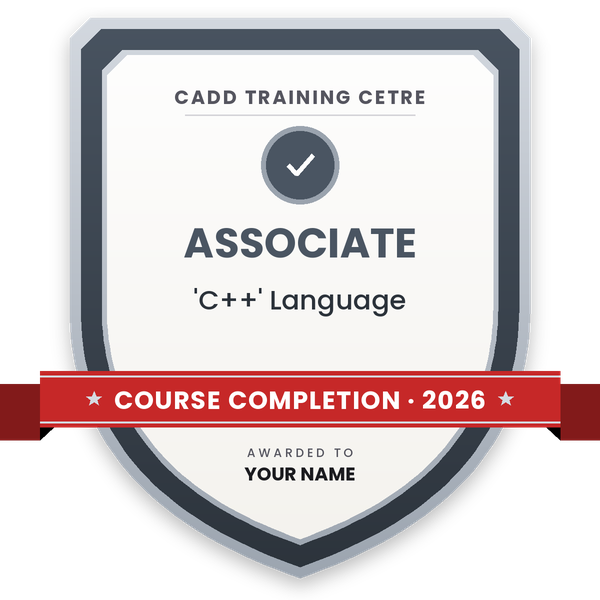
    Course-completion badge — Associate Course in 'C++' Language
    Course-completion badge
    Course
    Associate Course in 'C++' Language
    Issued by
    CADD Training Cetre
    Training
    Classroom or live online
    How to earn
    Complete the course and its project
    With your name and year · its own verify link · “Add to profile” on LinkedIn
  6. Certification exam

    Take the certification exam: a theory test and a practical task — at the centre or online.

  7. Certified certificate + marksheet

    Pass the exam and get the certified certificate with your marksheet. Anyone can check it online with its QR code.

  8. Certified badge

    Your certified badge — add it to LinkedIn and share it anywhere; it opens its own verify page.
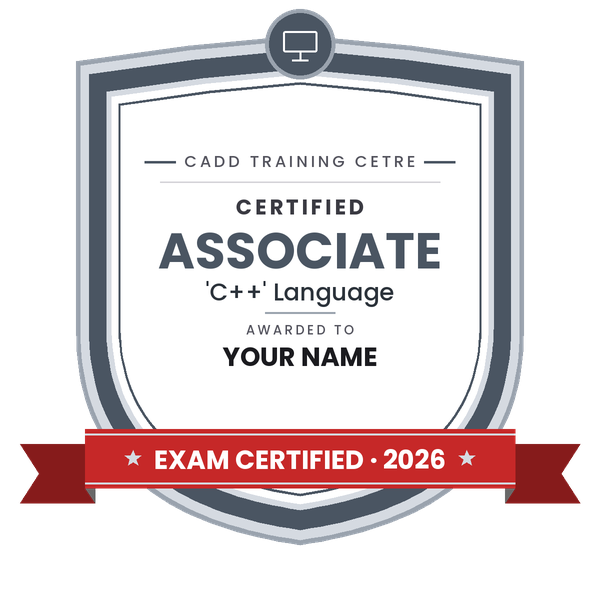
    Certified badge — Associate Course in 'C++' Language
    Certified badge
    Course
    Associate Course in 'C++' Language
    Issued by
    CADD Training Cetre
    Training
    Classroom or live online
    How to earn
    Pass the certification exam
    You also get
    Certified certificate + marksheet
    With your name and year · its own verify link · “Add to profile” on LinkedIn
  9. Make your CV & apply for jobs

    Make your CV in your student panel (Career → My CV) — your course, certificates and projects are added for you. Send it as a link with a preview picture, and apply to jobs and Hire Me requests from companies.

About the C++ Language course

C++ is a powerful, compiled programming language that combines the speed and low-level control of C with object-oriented and generic programming. It sits behind game engines, desktop applications, browsers, databases, operating system components and embedded devices, and it remains a favourite language for competitive programming and campus coding tests.

This 80-hour C++ programming course starts from the first program, so beginners can join. You set up a compiler and IDE, then work through data types, operators, control statements and functions, including references, default arguments, inline functions, overloading and recursion. Arrays, strings, pointers and dynamic memory with new and delete prepare you for object-oriented programming: classes, constructors and destructors, the this pointer, static members, friend functions, operator overloading, inheritance, virtual functions and abstract classes. Later chapters cover function and class templates, exception handling, file streams and the Standard Template Library with containers, iterators and algorithms. A mini project such as a library or bank management system ties everything together. Classes are hands-on, held at CADD centres or as live online sessions.

C++ builds a foundation for roles in software development, game programming, embedded systems and systems programming. Learners often continue with Data Structures, Java or Python.

You will be able to

  • Write, compile and debug C++ programs with a modern compiler and IDE
  • Use functions with default arguments, references, inline functions and overloading
  • Design classes with constructors, destructors, static members and friend functions
  • Apply inheritance, virtual functions and abstract classes for runtime polymorphism
  • Overload operators and write generic code with function and class templates
  • Handle errors with exceptions and work with files using fstream
  • Use STL containers, iterators and algorithms in a mini project

Who it is for

  • Students who know C and want to learn object-oriented programming
  • BCA, B.Tech, B.Sc. and polytechnic computer students
  • O Level and A Level students and competitive programming beginners
  • Learners planning a career in software, games or system programming

What you need

  • Basic computer skills; knowledge of C is helpful but not compulsory
  • Logical thinking and school-level maths
  • A Windows PC or laptop with at least 4 GB RAM and a stable internet connection for live online classes

Courses that include C++ Language

Associate Course in 'C++' LanguageAssociate Course · 80 Hours
Enquire →
Associate Course in 'C & C++' LanguageAssociate Course · 160 Hours · 2 software
Enquire →
Embedded Systems Engineer – Associate Career ProgramAssociate Career Program · 220 Hours · 3 software
Enquire →
Programming Using C, C++ and JAVA CoreAssociate Course · 240 Hours · 3 software
Enquire →
Embedded Systems Engineer – Professional Career ProgramProfessional Career Program · 320 Hours · 5 software
Enquire →

C++ Language Syllabus

11 chapters · 49 topics
01 Introduction to C++ 5 topics
  1. History and features of C++
  2. Setting up a compiler and IDE: g++, Code::Blocks or VS Code
  3. Structure of a C++ program
  4. cin, cout and namespaces
  5. Compiling, running and debugging
02 Data Types, Variables and Operators 4 topics
  1. Built-in data types and auto
  2. Constants and references
  3. Arithmetic, relational and logical operators
  4. Type conversion and casting
03 Control Statements 4 topics
  1. if, else if and switch
  2. for, while and do-while loops
  3. break, continue and nested loops
  4. Pattern and number programs
04 Functions 5 topics
  1. Function prototypes and definitions
  2. Call by value and call by reference
  3. Default arguments and inline functions
  4. Function overloading
  5. Recursion
05 Arrays, Strings and Pointers 5 topics
  1. One- and two-dimensional arrays
  2. C-style strings and std::string
  3. Pointers and pointer arithmetic
  4. Dynamic memory with new and delete
  5. Pointers to objects and arrays
06 Classes and Objects 5 topics
  1. Classes, objects and access specifiers
  2. Constructors, copy constructor and destructor
  3. The this pointer
  4. Static members and friend functions
  5. Encapsulation and data hiding
07 Operator Overloading and Type Conversion 4 topics
  1. Overloading unary and binary operators
  2. Overloading << and >> for I/O
  3. Conversion between class and basic types
  4. Rules and good practice
08 Inheritance and Polymorphism 5 topics
  1. Single, multiple, multilevel and hierarchical inheritance
  2. Virtual base classes
  3. Virtual functions and runtime polymorphism
  4. Abstract classes and pure virtual functions
  5. Virtual destructors
09 Templates and Exception Handling 4 topics
  1. Function templates
  2. Class templates
  3. try, catch and throw
  4. Standard exceptions and custom exception classes
10 File Handling and the STL 4 topics
  1. ifstream, ofstream and fstream
  2. Reading and writing text and binary files
  3. STL containers: vector, list, map and set
  4. Iterators and STL algorithms
11 Mini Project 4 topics
  1. Project planning with classes
  2. Library, bank or student management system
  3. Testing and code review
  4. Project presentation

Ratings & reviews

Students rate the course after they finish it — their ratings appear here.

C++ Language course — FAQ

What is C++ used for?

C++ is used for game engines, desktop software, operating system components, browsers, databases, embedded and high-performance applications. It is also popular in competitive programming.

Should I learn C before C++?

It helps but is not compulsory. The course covers the basics from the start, so beginners can join. If you already know C, you will move faster to object-oriented topics.

How long is the C++ course?

The C++ course is 80 hours of training. The counsellor will share the timetable for classroom and live online batches.

Can I learn C++ online?

Yes. You can attend live online classes or study in the classroom at a CADD centre. Online learners use a free compiler and editor on their own computer.

Will I get a certificate after the C++ course?

Yes. The C++ course leads to a CADD Training Centre certificate, which campus recruiters and employers can verify online by scanning its QR code or entering its unique code.

Is C++ hard to learn?

C++ has many features, but learning them in order makes it manageable. The course moves from basics to classes, inheritance, templates and STL, with programs to practise at every step.

What jobs can I get after learning C++?

C++ skills are used by software developers, game programmers, embedded software engineers and systems programmers, and they help in campus coding tests and interviews.

More questions? Ask our counsellor or read the general FAQ.
C++ Language80 Hours
Enquire now