A store and material executive receives, stores, issues and tracks materials so production and projects never stop for want of stock. This roadmap covers material management, stock records in Excel and inventory in Tally.
Understand procurement, receiving, inspection, storage, issue, inventory control methods, stock valuation and the store documents used in Indian companies.
Build stock registers, receipt and issue sheets and reorder lists using formulas, sorting, filtering and simple charts for weekly reports.
Create stock items, groups and units, and record purchases, receipts, issues and sales so that stock and accounts stay matched.
Work with more advanced Tally features for inventory, purchase and sales, including stock reports and the GST details that appear on bills and invoices.
Use advanced formulas, lookups, PivotTables and charts to prepare consumption, stock ageing and stock value reports for management.
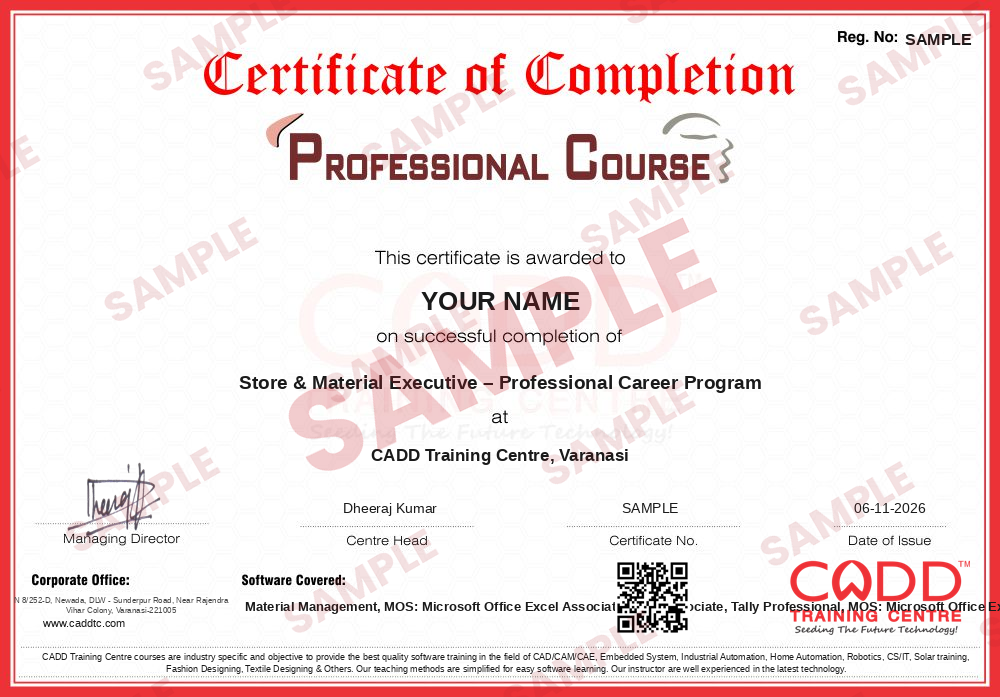
Finish the program and its project — you get the course-completion certificate and a digital completion badge with your name.
Take the certification exam: a theory test on the software of the program and a practical task of the job — at the centre or online.
Pass the exam and get the certified certificate with your marksheet. Anyone can check it online with its QR code.
Your certified badge — add it to LinkedIn and share it anywhere; it opens its own verify page.
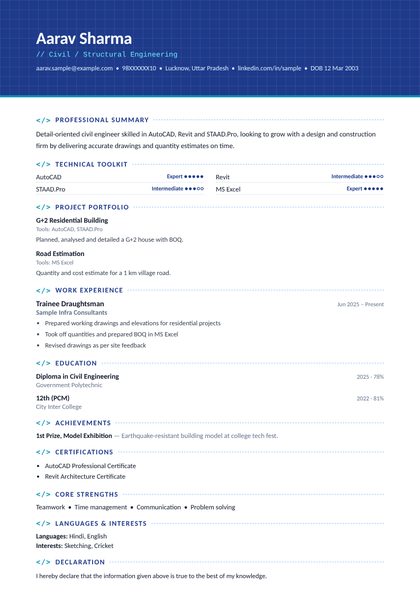
Make your CV in your student panel (Career → My CV) — your program, certificates and projects are added for you. Send it as a link with a preview picture, apply to jobs and answer Hire Me requests from companies.
The counsellor can shorten or extend this plan for your qualification and the time you have. Ask for your personal plan →
Join at the level that suits you — each level is a complete course you can enrol in.
Entry job — the first steps of the roadmap
The whole roadmap — every software of the job
A store and material executive looks after the materials a factory, project site or business depends on. Daily work includes receiving goods against purchase orders, checking quantity and quality with the inspection team, preparing goods receipt notes, storing items in proper locations, issuing material against approved requisitions, entering every movement in the stock register or software, carrying out physical stock checks and keeping records ready for audits.
Store executives work in manufacturing plants, construction and infrastructure project sites, warehouses and distribution centres, hospitals, hotels, retail chains, engineering and fabrication units, and trading businesses. On large projects the role usually sits in the stores, purchase or materials department.
Material is one of the biggest costs in most businesses, and poor store records lead to stock-outs, excess inventory, losses and audit problems. Companies therefore value a store executive who keeps accurate records, understands stock valuation and can produce clear reports in Excel and Tally. It is a practical career for ITI, diploma and commerce candidates, and store experience can lead to purchase, inventory control and supply chain roles.
Learn material management basics, store documentation, Excel and Tally inventory. Start as a store assistant in a factory, warehouse or project site, learn the company's process, and you can grow into a store executive role.
Many companies hire store staff with 12th, ITI, diploma or a commerce degree. Practical knowledge of store procedures, Excel and Tally usually matters more than the specific qualification.
Yes. Many small and medium businesses keep their inventory and accounts in Tally, so a store executive who can record receipts, issues and stock transfers there saves time and avoids mismatches with accounts.
Both build the same core skills. Factory stores have steady routines and many item types, while site stores handle bulk material, frequent issues to contractors and fast-changing needs. Choose based on where you want to build your career.
Yes. Large companies often use ERP systems such as SAP or Oracle for material management. The concepts are the same, and someone with strong store basics, Excel and Tally can learn an ERP system on the job.
Yes. CADD Training Centre runs live online classes as well as classroom batches. You will need a computer to practise Excel and Tally entries regularly.
More questions? Ask our counsellor or see all career roadmaps.
 Project Planning Engineer (Primavera / MS Project)A project planning engineer builds and tracks the schedule that keeps a construction or engineering project on time. This roadmap covers Excel, reading drawings, MS Project, Primavera P6 basics and advanced, and 4D planning.
 Mechanical Design EngineerA mechanical design engineer turns product ideas into 3D models and manufacturing drawings. This roadmap takes you from drawing basics to SolidWorks modelling, sheet metal, GD&T and simulation.
 Product / Industrial DesignerProduct and industrial designers shape how everyday products look, feel and get made. This roadmap builds surface modelling, design-for-moulding and photoreal rendering skills for a strong design portfolio.
 CAE / FEA AnalystA CAE / FEA analyst uses simulation to predict stress, vibration, heat and fluid flow before a product is built. This roadmap moves from 3D CAD to Ansys structural and CFD work plus result scripting.
 CNC ProgrammerA CNC programmer writes the G-code and CAM toolpaths that run turning and milling machines. This roadmap covers drawing reading, CNC operation, NC editing, part modelling and Mastercam programming.
 Automotive Design Engineer (CATIA / NX)Automotive design engineers create body, trim, chassis and powertrain parts for vehicles. This roadmap builds the CATIA and NX part, assembly and surface skills that carmakers and their suppliers expect.