A CAE / FEA analyst uses simulation to predict stress, vibration, heat and fluid flow before a product is built. This roadmap moves from 3D CAD to Ansys structural and CFD work plus result scripting.
Analysts constantly create, simplify and repair geometry. Strong CAD skill lets you defeature models and prepare clean parts for meshing.
Learn the FEA workflow on simple parts: material, fixtures, loads, mesh and results, inside a familiar CAD interface.
Static, modal, contact and thermal studies with proper meshing and convergence checks. This is the core skill asked for in most FEA analyst openings.
Simulate internal and external flow, pressure drop and heat transfer in ducts, pumps, valves and enclosures, and post-process velocity and pressure fields.
Write scripts to handle result data, plot trends, compare with hand calculations and automate repetitive simulation tasks.
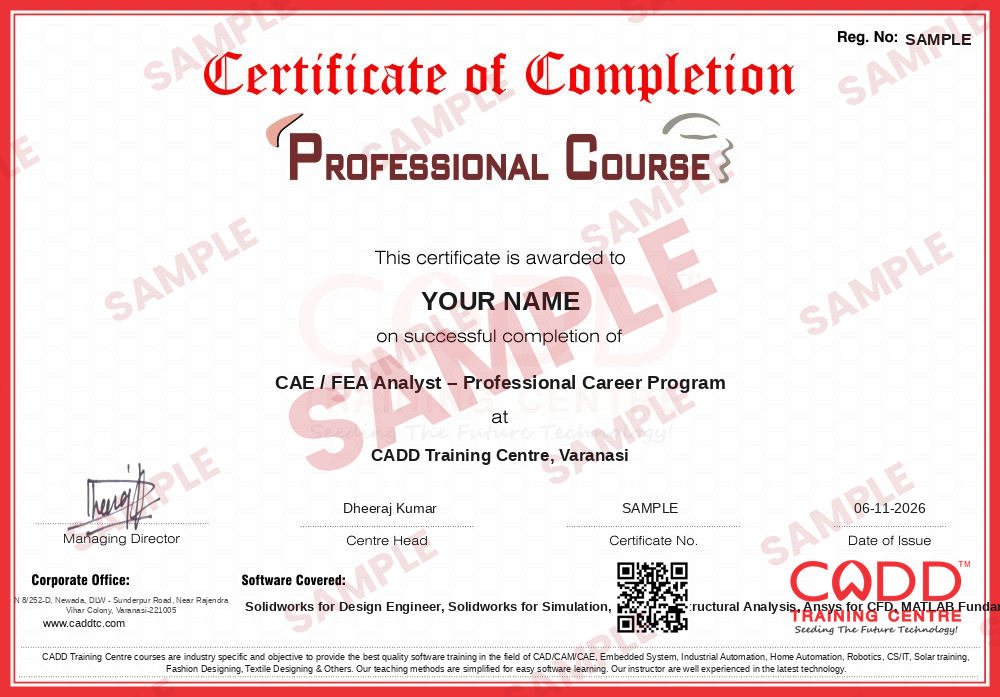
Finish the program and its project — you get the course-completion certificate and a digital completion badge with your name.
Take the certification exam: a theory test on the software of the program and a practical task of the job — at the centre or online.
Pass the exam and get the certified certificate with your marksheet. Anyone can check it online with its QR code.
Your certified badge — add it to LinkedIn and share it anywhere; it opens its own verify page.
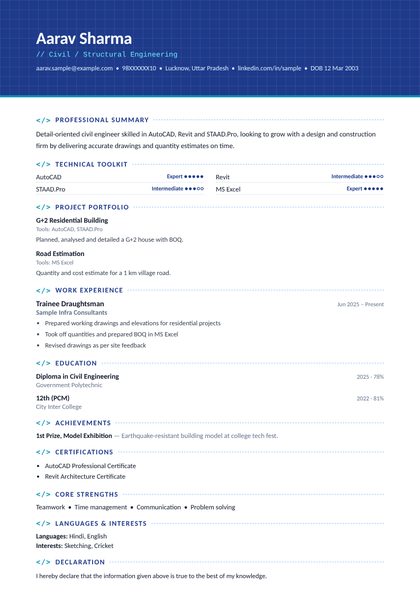
Make your CV in your student panel (Career → My CV) — your program, certificates and projects are added for you. Send it as a link with a preview picture, apply to jobs and answer Hire Me requests from companies.
The counsellor can shorten or extend this plan for your qualification and the time you have. Ask for your personal plan →
Join at the level that suits you — each level is a complete course you can enrol in.
Entry job — the first steps of the roadmap
The whole roadmap — every software of the job
A CAE / FEA analyst checks whether a design will survive real loads using computer simulation. Daily work includes cleaning up CAD geometry, meshing, applying materials, loads and boundary conditions, solving the model, and then reading stress, deformation, temperature or flow results to tell the design team what must change.
Typical studies cover static strength, fatigue, vibration (modal analysis), heat transfer, and fluid flow through pumps, valves and ducts or around vehicles. The analyst writes clear reports and often compares results with hand calculations or physical tests.
Employers include automotive and aerospace suppliers, heavy engineering and energy companies, pump and compressor makers, electronics firms and engineering service companies that run simulation projects for global clients. Demand exists because simulation cuts the number of physical prototypes and test failures, and because a strong analyst needs both software skill and sound fundamentals in strength of materials, heat transfer and fluid mechanics.
Revise strength of materials, then learn CAD and FEA in steps: SolidWorks modelling, SolidWorks Simulation and Ansys Structural, followed by Ansys CFD. Complete two or three documented case studies to show in interviews.
FEA (finite element analysis) mainly predicts stress, deformation, vibration and temperature in solids. CFD (computational fluid dynamics) predicts the flow of liquids and gases, pressure drop and convective heat transfer. Many CAE roles need both.
Ansys is widely used for structural and CFD work. Other industry tools include Abaqus, HyperMesh and Nastran. This roadmap uses SolidWorks Simulation and Ansys, plus MATLAB and Python for data handling.
The roadmap totals about 360 hours: SolidWorks 80, SolidWorks Simulation 20, Ansys Structural 80, Ansys CFD 80, MATLAB 40 and Python 60. Real confidence also needs practice projects.
Most CAE openings ask for a B.Tech or M.Tech because the work relies heavily on engineering theory. Diploma holders usually start in CAD and move towards simulation after further study and experience.
Yes. Ansys modules are offered in live online classes as well as in classrooms. You need a reasonably powerful computer, since meshing and solving larger models takes memory and processing power.
More questions? Ask our counsellor or see all career roadmaps.
 Mechanical Design EngineerA mechanical design engineer turns product ideas into 3D models and manufacturing drawings. This roadmap takes you from drawing basics to SolidWorks modelling, sheet metal, GD&T and simulation.
 Product / Industrial DesignerProduct and industrial designers shape how everyday products look, feel and get made. This roadmap builds surface modelling, design-for-moulding and photoreal rendering skills for a strong design portfolio.
 CNC ProgrammerA CNC programmer writes the G-code and CAM toolpaths that run turning and milling machines. This roadmap covers drawing reading, CNC operation, NC editing, part modelling and Mastercam programming.
 Automotive Design Engineer (CATIA / NX)Automotive design engineers create body, trim, chassis and powertrain parts for vehicles. This roadmap builds the CATIA and NX part, assembly and surface skills that carmakers and their suppliers expect.
 MEP Design EngineerMEP design engineers plan HVAC, plumbing, fire fighting and electrical services for buildings. This roadmap moves from AutoCAD drafting to AutoCAD MEP, Revit MEP modelling and Navisworks coordination.
 Steel Structure Detailer (Tekla / Advance Steel)A steel structure detailer models steel buildings and produces the fabrication and erection drawings shops and sites work from. This roadmap covers drawing basics, AutoCAD, Advance Steel, Tekla Structures and STAAD Pro.