PLC / SCADA automation engineers program the controllers and operator screens that run machines and process plants. This roadmap covers control drawings, Allen-Bradley PLC logic, InTouch SCADA and Python.
Learn relay logic, motor starter circuits, PLC I/O drawings and panel wiring diagrams. Ladder logic grew out of relay circuits, so this makes PLC programming easier.
Ladder logic, timers, counters, compare and math instructions, analog I/O and online troubleshooting on Rockwell Automation PLCs used in many plants.
Create operator screens with tags, animations, alarms, trends and reports, and connect them to PLC data to monitor and control a process.
Use scripts to log, analyse and report machine data, a growing need as plants connect PLCs and SCADA to dashboards and IIoT platforms.
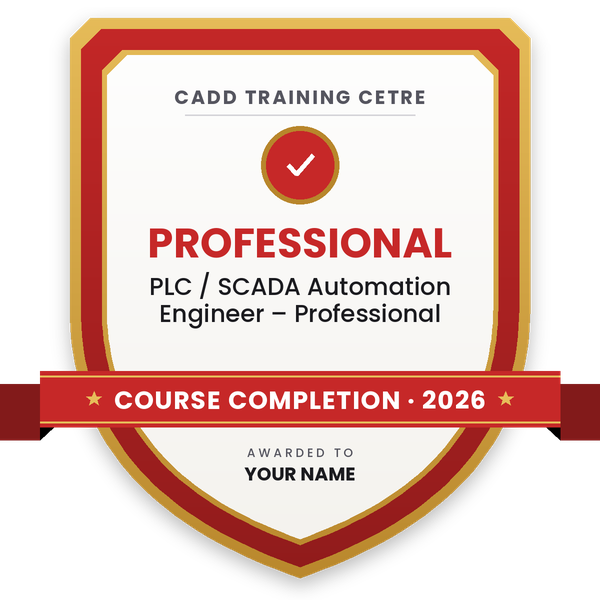
Finish the program and its project — you get the course-completion certificate and a digital completion badge with your name.
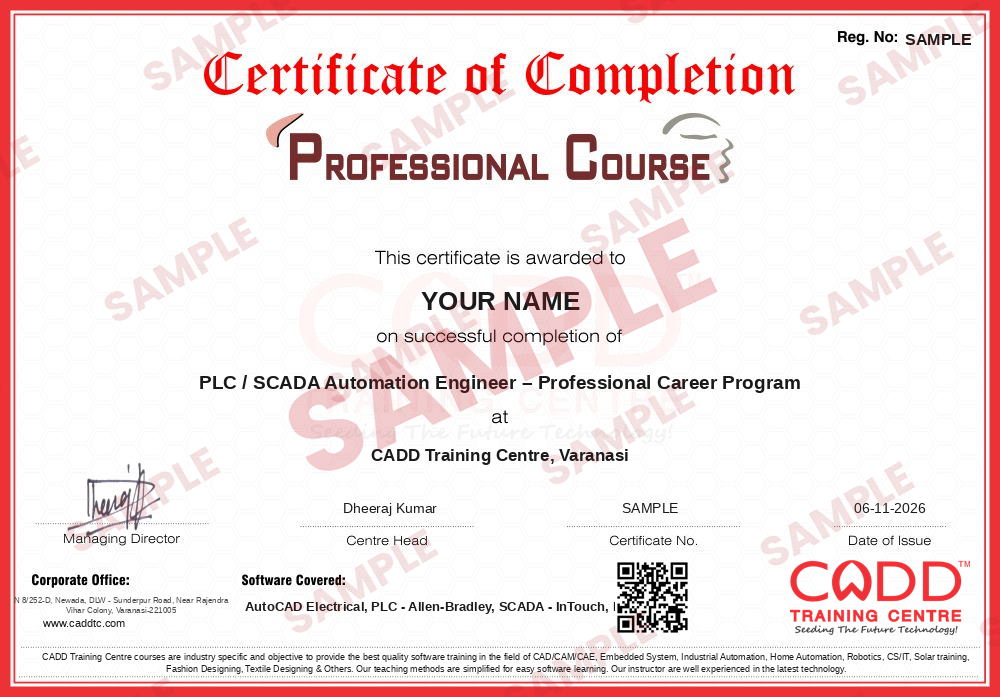
Take the certification exam: a theory test on the software of the program and a practical task of the job — at the centre or online.
Pass the exam and get the certified certificate with your marksheet. Anyone can check it online with its QR code.
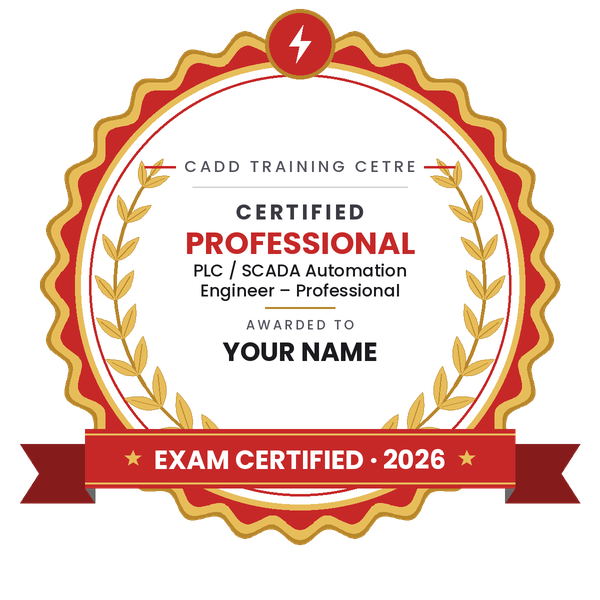
Your certified badge — add it to LinkedIn and share it anywhere; it opens its own verify page.
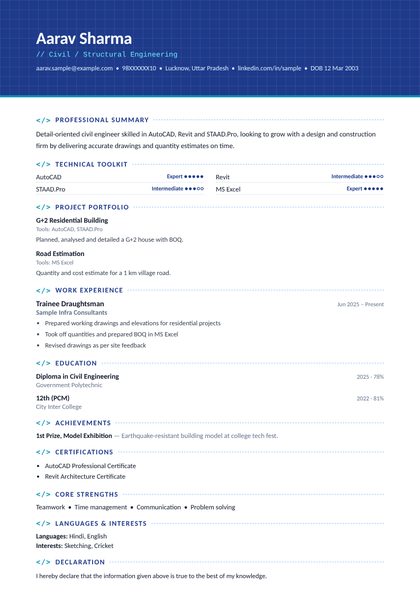
Make your CV in your student panel (Career → My CV) — your program, certificates and projects are added for you. Send it as a link with a preview picture, apply to jobs and answer Hire Me requests from companies.
The counsellor can shorten or extend this plan for your qualification and the time you have. Ask for your personal plan →
Join at the level that suits you — each level is a complete course you can enrol in.
The whole roadmap — every software of the job
A PLC / SCADA automation engineer makes machines and plants run on their own. They read control drawings, write PLC programs in ladder logic and other languages, configure analog and digital I/O, build SCADA and HMI screens with alarms and trends, and test everything with the mechanical and electrical teams during commissioning.
Daily work can be in an office writing and simulating logic, or on site checking sensor wiring, forcing outputs, tuning sequences and fixing breakdowns. Good engineers also document their programs clearly so maintenance teams can troubleshoot later.
Employers include system integrators, control panel builders, machine and packaging line manufacturers, and plants in automotive, pharmaceuticals, food and beverage, cement, steel, power, and water and wastewater treatment. Industries keep adding automation to improve quality, safety and productivity, and older plants are upgrading relay panels to PLC and SCADA systems, which creates regular demand for people who combine electrical knowledge with programming skill.
Learn to read and draw control circuits, then study PLC programming with Allen-Bradley and SCADA screen design with InTouch. Practise on small projects such as a motor sequence or tank level control, and look for trainee roles with system integrators.
A PLC is an industrial controller that reads sensors and switches outputs according to its program. SCADA is software on a computer that shows the process to operators, raises alarms, records trends and sends commands to PLCs.
Allen-Bradley (Rockwell Automation) and Siemens are widely used in Indian plants, along with Mitsubishi, Schneider and others. Once you understand ladder logic on one brand, moving to another is mainly learning a new software environment.
This roadmap takes about 220 hours: AutoCAD Electrical 60, PLC - Allen-Bradley 60, SCADA - InTouch 40 and Python 60. Site and commissioning experience then builds confidence.
Yes. ITI electricians and instrument mechanics already know wiring and field devices. With PLC and SCADA training they can start as automation technicians and grow into engineer roles with experience.
Yes. PLC and SCADA software, simulation and logic can be learned in live online classes. Hands-on wiring practice on real hardware also helps, so try to get time on a PLC trainer kit or at a plant.
More questions? Ask our counsellor or see all career roadmaps.
 Electrical Design EngineerElectrical design engineers prepare schematics, panel layouts and building power and lighting drawings. This roadmap covers AutoCAD, AutoCAD Electrical, Excel load schedules and Revit MEP modelling.
 MEP Design EngineerMEP design engineers plan HVAC, plumbing, fire fighting and electrical services for buildings. This roadmap moves from AutoCAD drafting to AutoCAD MEP, Revit MEP modelling and Navisworks coordination.
 Embedded Systems EngineerAn embedded systems engineer programs the microcontrollers inside electronic products. This roadmap takes you from C and C++ through Arduino hardware, Proteus simulation and Python to entry-level firmware work.
 BIM CoordinatorA BIM coordinator brings architectural, structural and MEP models together, resolves clashes and keeps the project model on standard. This roadmap covers Revit in all disciplines, Navisworks, Dynamo and cloud collaboration.
 Solar PV Design EngineerA solar PV design engineer plans rooftop and ground-mounted solar plants, from panel layout and shadow checks to energy yield and electrical drawings. This roadmap covers AutoCAD, SketchUp, PVsyst, AutoCAD Electrical and Excel.